
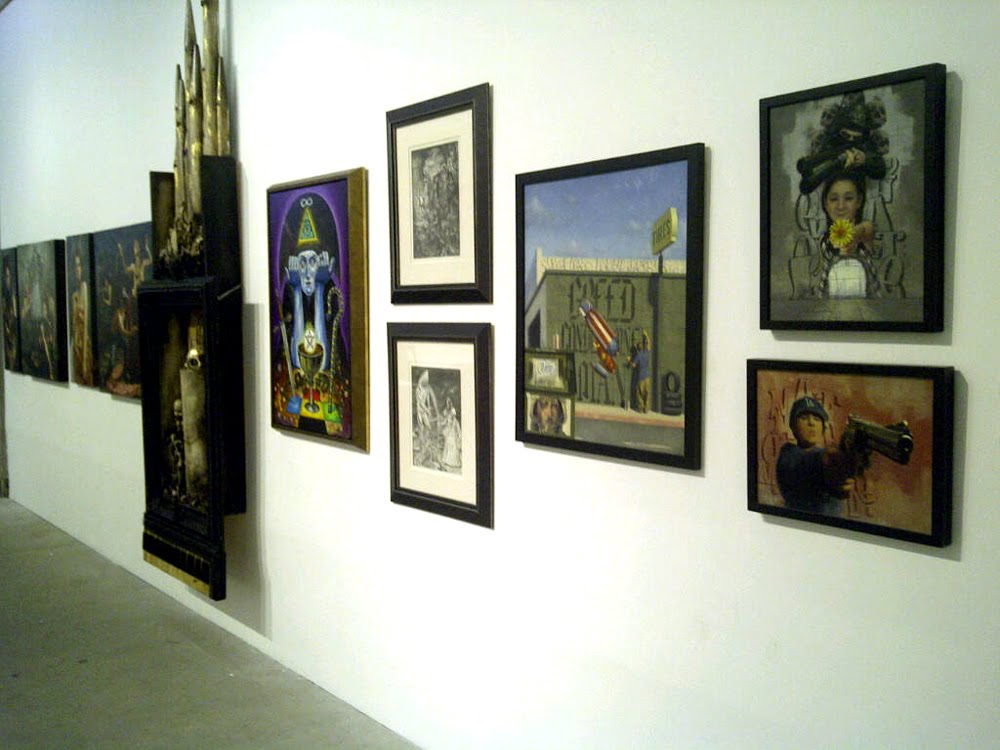


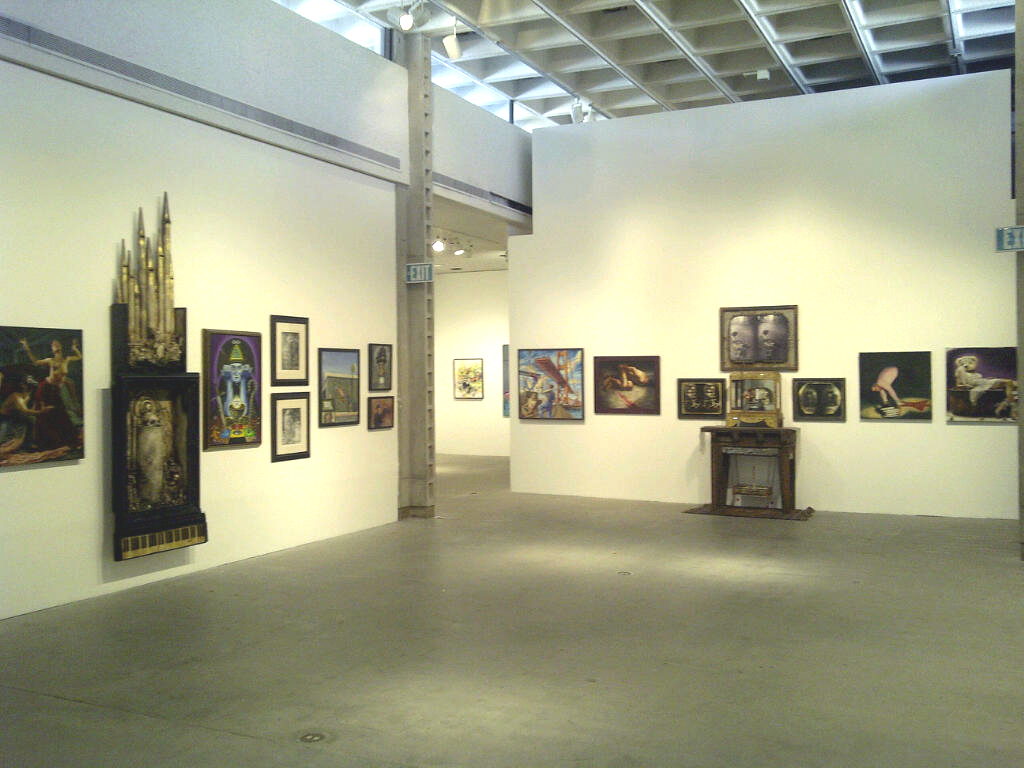


 Simply Iconic is the title and the words I would use to describe the current exhibition at La Luz De Jesus Gallery located on Hollywood Blvd in the quaint region of Los Feliz. The breathtaking collection of work from seven Southern-raised, African American artists hold such a pure and intuitive energy. The exhibition includes work from Purvis Young, Sam Doyle, Charlie Lucas, O.L. Samuels, Sulton Rogers, Roy Ferdinand, and Herbert Singleton. Each artist has an interesting story that describes their passageway into the art making realm. This art is extremely un-pretentious and brilliant, coming from people who decided mid-way through life to embark on their artistic journey. The work is so honest and moving, resembling folk-art, but speaking in a deeply soulful way that grabs the attention of the so-called “High Art” crowd. It’s actually quite refreshing to see work like this in the La Luz De Jesus, which is a gallery that seems to appeal to the art genre of Pop Surrealism or Low-Brow. However, upon speaking with the curator, Matt Kennedy, the Simply Iconic collection (owned by Gordon Bailey) seemed to be a perfect fit. It is art that makes a statement with the way in which it is made, not necessarily the conceptual aspect. That being said, just because a piece of art is not considered to be “conceptual”, doesn’t mean that it lacks depth. I actually feel that crafty art can speak in a very pure way. The work holds the essence of one’s personality or being, as if parts of the artist’s soul are transferred into the piece as they work. Heavy concept is written in the paint, in the wood, in the clay. To cite one of my favorite conceptual artists of all time, Yoko Ono, “The medium is the message.”
 talk about is Sam Doyle (1906-1985), a man who considered himself more of a historian rather than an artist. He was interested in documenting events that took place in his home town of Saint Helena, South Carolina, by means of painting and displayed the works in his backyard, which became known as a sort of outdoor museum. His work is executed with the pure, unadulterated expression of a child, so in a sense it is very liberating to witness. The paintings are done on large scale pieces or tin or wood with house paint. There is an essence about the work that feels very touched and worked with, lived with, like a piece of old furniture that holds on to memories. In fact, the work seems to be replications of memories. As Doyle once said “I paint from, I would say, the mind’s eye”. In my opinion, Doyle somewhat paved a gateway for neo-expressionism. One of his biggest fans was the famous Jean Michel Basquiat, who, at one point, actually traded all of the work in one of his shows for two Sam Doyle paintings. Another appreciator of Doyle is Ed Ruscha, who created a body of work as a tribute to Sam Doyle, which was purchased by Edith and Eli Broad.
 work in the center of the gallery that is quite mystifying. Dark animal figures accented by glittering rainbow colors seem to watch over the room in a haunting sort of way. Samuels began making work after he was in a life threatening accident in which he was hit by a falling tree trunk while working as a tree surgeon. After the accident he became incredibly depressed. One day the voice of his grandmother, who was a freed slave, floated into his mind. She suggested carving a spool as a means to get out of depression. He felt so compelled to create upon remembering this old advice given to him by his grandmother, and began carving dreamy figures out of wood. The three works that are displayed in this collection are “Dog”, “Horse” and “Ickitty Chicks” , all made in the 1980’s. Each piece is painted black and is textured and colored with a concoction Samuels cooked up in his kitchen out of glue, saw dust, glitter and paint. So his work has this beautiful dark magic vibe to it. Although the work was full of color, Samuels was in fact, color-blind. When people would ask him why he used such an intense gradient of rainbow hues in his work, he replied that he was only using so many colors to make sure that he got the right one. What I found most interesting about Samuels wooden friends, was that each piece seemed to actually have a soul. The eyes of each figure were very captivating in a human-like way. All the figures were carved out of wood, but he used different materials for the eyes. Some had amber-colored marbles for the eyes and some had raven stones, even some had beer bottle caps. I actually felt myself very entranced by his work, as if the observation wasn’t exactly one-sided. I felt his work observing me, looking into me. His creatures seem to be psychically connected to everything and everyone around them.
 light-hearted approach to the art of whittling, compared to the sultry depths displayed in the work of his counterpart, O.L. Samuels. Rogers was taught wood carving as a child by his father. His tool of choice was his pocket knife. His small to medium scale wooden sculptures are smoothly worked allowing viewers to get lost in the simple patterns in the wood-grain. There is a boyish grit to the work that is actually a bit humorous and endearing. His piece, “Devil Family” (1990’s) depicts a group of red devils with pitchforks, nude and lustful, with delicately detailed genitals and pubic hair to form the perfect family, mother, father, and two children, a boy and girl. The juxtaposition of something considered evil or lusty with the ideal of a loving wholesome family is pretty amazing. Although Sulton Rogers was making this kind of work in the 1990’s when he was in his 70’s, there is incredibly boyish nature to his figures.
 take the role of the bad boy in this collection, an artist who spent many years in and out of jail, and suffered through serious drug addictions. In contrast to the dark yet heavenly aspects of Samuels work, Singleton makes work that is just plain dark and hellish, including themes of voodoo and disease. He used a lot of opaque primary colors on carved bas-relief wood pieces. The imagery is painful and characterized by religious symbols and themes. Snakes seem to slither their way into a lot of his work. Most of the work is pictorial, but there are also some interesting totem-like masks on the wall resembling tribal African art. The most chilling of his paintings is entitled, “The Old Religion”, in which a person holding bone is sitting in a black caldron over a wild fire, while a man comes in with an enormous snake. Singleton’s work is very narrative and tells a dark, creepy story. It’s a bit like witnessing a car crash or like watching someone have a nervous breakdown right in front of you. Something you feel like you shouldn’t be so enthralled by, but you just can’t help it.
 On the same wall as Singleton is the work of the esteemed “Goya of the Ghetto”, Roy Ferdinand (1959-2004) from New Orleans. His work has been described as “Rap in pictures” by his appreciators. His medium scale drawings are actually quite unsettling. There are many factors that come together to create this effect. First and most importantly is the imagery itself, which is very graphic and even border-lining on violent, then the quality of line and texture, and lastly the proportions of the figures depicted in his works. The line-work is manic, particularly the cross-hatching. Each piece is sort of vibrating with a bi-polar sense of line and texture. Parts of the piece are rendered in a soft patient manner, and other parts are fast and neurotic. The scenes displayed in this group of work are very honest and real, showing people from the streets of New Orleans, and one piece that depicts a baptism in a lake near a Southern Baptist church. Ferdinand’s work makes a lot of sense on the same wall as Singleton. The two artists create work that speaks in a painful tone, and seem to relate to each other in similar ways.
 romantic of the group was motivated to create work by a need to spread peace to the world. His work resembles early expressionism, and even seems to unknowingly take from artists like William DeKooning because of his visionary emotional nature. His work is a lovely contrast to the works of Singleton and Ferdinand. Young enjoyed painting dreamy, mirage-like, spiritual scenes on scavenged pieces of wood. One piece was even painted on a piece of wood that had once been a step in an old factory. His color usage is soft and vibrant with lots of sea-greens and turquoises with hints of warm yellows mimicking light. There is a lot of movement in his work as well, creating this feeling that you are witnessing a reunion of angels dancing in a celebration of peace. The imagery holds a warm transcendental, ethereal energy, while the scavenged wood holds the energy of life. So many hands have touched that wood before Young was able to paint on it, so the actual wood itself seems to tell a story. I found his body of work to be the most poetic and inviting.
 is very playful and lively. Like Samuels, Lucas also suffered from a life threatening accident in the 1980’s, and decided to take up painting shortly after his recovery. Lucas strikes me as the type of artist who really just loves to explore mediums. His paintings and mixed-media works exude a sense of excitement and discovery. There is a simple yet chaotic nature to Lucas’s work that is a bit disorienting. The work is all pretty flat, but accented by textured surfaces, like shattered glass, for example. What I love about Lucas is the way he used the materials, with such enthusiasm! Every piece is a type of journey, a new territory for opportunities to use new kinds of media, texture, and color.


 grew from a tangle of roots joining the DIY punk scene of the 1980s with guerilla art, surrealism, and nostalgia for the psychedelic 60s. Emily the Strange came to life in the early 1990s and became a beloved counterculture icon all around the world moving quickly from a sharp-witted T-Shirt sloganeer to the subject of gift books, comics, and ultimately a series of novels for young adults. She continues to be a voice for individualism, but in a greater context has become an icon of non-conformity. In many ways, Emily the Strange is the Mr. Natural of the middle school set, and like Robert Crumb (who also found fame in the Bay Area), Rob Reger must walk a tightrope between the two very different worlds of fine art and pop-recognition. Unlike Crumb, Reger is incredibly accessible, business savvy, and plugged into a network of friends and colleagues who have already reached that next plateau; people like Tim Biskup, who successfully charted a course of pop-sensibility, fine art acceptance and overall success. While neither yet has attained the kwan of Murakami, Biskup's art is personally collected by museum curators, gallerists, other artists, celebrities and captains of industry, and it's only a matter of time before an extra set of zeroes suffixes his current price points (which are none-too-shabby as is). And Reger's influence over two generations of young girls could easily follow the purchasing trends of Baby Boomers who grew up in the original age of Pop Art, eventually setting record purchase prices for Andy Warhol, Jean-Michel Basquiat and Jeff Koons. If the history of the twentieth century has taught us nothing else about marketing and collectibility, it has at least taught us that children become adults who make enough money to buy back their childhoods. Now, in the twenty-first century, that process seems to have expedited; millionaire twenty-somethings are blowing a lot of loot on nostalgia from the previous decade (exemplified by Justin Timberlake's recent purchases of Michael Jackson memorabilia).
 Rob Reger has taken a handful of elements from his best-known work (bats, cats, and Emily) and produced a series of paintings that can be viewed from multiple angles, welcoming an abstract element to his mainly figurative work. He also priced everything quite affordably, reflecting the current economic climate but also welcoming early collectors, much like Keith Haring and Yoshitomo Nara did in the formative years of their exhibition cycles. Reger has created a body of work with maturity and sophistication that embraces the recognizable without catering to easy money. Investment-minded parents would be wise to buy now and bestow later. What a cool graduation present one of his paintings will make some day for your eleven year old daughter. I'm not saying that it will help pay off her college loans, but it might...
 THE ENCYCLOPAEDIA OF HELL
What do Lemmy, Coop and Ben Vereen all have in common? They're here!
A tour de force of darkness, Encyclopaedia of Hell is a manual of Earth written by Lord Satan for his invading hordes of demons, complete with hundreds of unpleasant illustrations, diagrams, and a comprehensive and utterly repulsive dictionary of Earth terms.
Since the customs and mores of humanity are alien and inconceivable to demons, Satan wrote this strangely poetic military handbook for the enlightenment and edification of his demon armies. A masterpiece expressing Satan's hatred for humanity and himself, the Encyclopaedia includes "Techniques of Stalking and Eating Humans," "Methods of Canning Human Pus," and "Dicing and Slicing Orphaned Children."
Why the invasion? During the last century in particular, Hell has become seriously overcrowded. Satan needs more land mass for the damned and to use the human livestock to feed his hungry demon invaders. Since this book is the 666th commemorative edition, this Encyclopaedia contains special commemorative material.
Martin Olson's savage wit provides the firepower for a preposterous literary feat unaccomplished since Mark Twain passed—channeling the real voice of Satan. Over the past fifteen years, Olson has written and produced nine comedy specials, inflicted on the populace via CBS, HBO, Showtime, Cinemax, and A&E.
"[An inferno] is probably just where Martin Olson was sitting when tasked with translating The Encyclopedia of Hell. How he learned to speak demonic is anybody’s guess. What’s more puzzling is where Olson got the nerve to actually translate the text in the first place. After all, it is An Invasion Manual for Demons Concerning the Planet Earth and the Human Race Which Infests It. Hardly the kinda thing one wants to bring home to baby. Maybe Olson’s a demon himself. If you wanna learn how the evil see us, this Encyclopedia is all you’ll need."
– SunPost Weekly July 28, 2011 | John Hood
“The Encyclopaedia of Hell” – written by Martin Olson, illustrated by Tony Millionaire and Mahendra Singh. 2011. Paperback, 240 pages in English published by Feral House, ISBN-13: 978-1936239047
About The Author
Martin Olson has written and produced nine comedy specials, inflicted on the populace via CBS, HBO, Showtime, Cinemax and A&E. As a composer, he has been honored with a 2010 Emmy Nomination for Songwriting, a 2009 Emmy Nomination for Primetime Songwriting, and a 1997 Annie Award Nomination for Songwriting in an Animated Series. This is his first book.
 said Sam Doyle, who fashioned his personal portraits and tributes with evangelical enthusiasm, blending ancestral Gullah lore and his devout Baptist faith into a multi-cultural impasto. As a youth, Doyle attended Penn School, established in 1862 to provide educational and vocational skills to newly liberated slaves. Following his retirement in the late 1960s, Doyle fully committed to painting the history of his beloved Gullah community and more generally African-American advancement. Over the next decade his museum-like exhibition evolved into the St. Helena Out Door Art Gallery where haints and saints rubbed rusty shoulders and shared the boughs of Spanish moss laden oak trees with other celebrated figures.
 sort of 'Goya of the ghetto,' Ferdinand has described his work as rap in pictures, while some critics have placed his utterly honest depictions of inner city decay within the social realist tradition of Courbet. "I've been around long enough to know what's good and what's not good, and I instantly knew that Roy was good," says Willie Birch, a nationally prominent African-American artist who nominated Ferdinand for inclusion in the 2001 New Orleans Triennial.
 Man," Charlie Lucas has attracted a large following. In recent years, he has traveled widely, lecturing at Yale University at the invitation of an African-American studies scholar and spending time as an artist-in-residence in France. A job-related accident in 1984 forced Lucas to give up his job as a maintenance man at a healthcare facility. While recovering from back surgery, he asked God to help him find something to do that no one else could do. Soon he began fashioning sculpture out of recycled metal. Gradually, his creations morphed in two directions: upward, to towering, gigantic men made entirely of spot-welded steel ribbons and 12 to 15-foot dinosaurs and downward, to 10 to 15-inch men and animals made of railroad spikes and bent wire. Although he has no formal art training, Lucas' sculptural work clearly combines skills he learned from observing his grandfather's mechanical and automotive repair techniques, his grandmother's basket-weaving, and his great grandfather's blacksmithing.
 taught woodcarving as a child by his father, who Rogers claimed could "build anything." Rogers' fantastic wood figures and captivating parings are renowned for their satirical style, mirroring the apparently amenable character of the artist himself. Rogers spent many years away from Mississippi, joining the army and later traveling through numerous states in the early 1950s before finally settling in New York State and finding work as a foreman. The boredom of the job led him to carve in earnest, which he continued to do following his retirement and return to Mississippi. Rogers carved his figures with a pocketknife, then painted his creations with acrylic. Most themes are human-related, but Rogers also enjoyed depicting snakes, 'haints' (spirits) and vampires, with occasional sexual or erotic references. His humans sometimes have exaggerated and comedic features, or amusing facial expressions. Rogers claims inspiration from dreams or people he has met during his travels.
 the age of 8 to work as a pineraker on Georgia farms, and, later, for the railroad. He boxed professionally as a middleweight. Samuels has had many near misses with death: his home was dynamited after he complained to the cops about drug-dealing in the neighborhood; he was knifed; and, in 1982, while working as a tree surgeon, he was hit in the head by a swinging trunk. He barely survived that event and was confined to a wheelchair. Samuels fell into a deep depression. The words his great great grandmother, a freed slave, told him long ago finally pulled him out of his sadness. She told him that when a person became sad he could carve on a spool and it would help him heal. Samuels took her advice and picked up some wood and started carving. Although he is colorblind, he paints his carvings and says the colors seem to match up. He combines paint, glitter, sawdust, and glue into a secret formula, which he warms on the stove, and applies to his wood sculptures. Samuels explains, "They ask me why I use so many colors and I say I want to be sure I get the right one." .Samuels' unique artwork is in a number of important collections including the Smithsonian American Art Museum.
 derived meaningful income from artistic endeavors in the early 1980s, carving walking sticks for New Orleans buggy drivers and "voodoo protection" stumps for friends. After his final stint of incarceration, the dispirited artist was encouraged by a French Quarter gallery owner to carve out his pain. Singleton dismantled an old chifforobe and created his first bas-relief panel: a stark white skeletal figure cut out of a black background, bordered by red. The heads of serpents are shown peering from the "infected" figure's ribcage. In works such as "Who Do We Trust" and "Who Speak For Man" Singleton addressed our seeming inability to meet the standards we set for others. In one masterwork, he carved self-destructive indulgences -- drugs, gambling, sex -- into a huge cypress log he salvaged from the Mississippi River. Exhibited as the "Algiers Rosetta" in High on Life: Transcending Addiction at the American Visionary Art Museum, Singleton referred to his work more directly as the "Tree of Death." In other more festive works he paid tribute to the uniqueness of New Orleans culture. Singleton's artworks are in numerous important public and private collections worldwide including the Smithsonian Institute in Washington, D.C., and Collection de l'Art Brut in Lausanne, Switzerland.
 problems of the world." said Purvis Young. He often wore dark glasses to "hide his tears" at the injustice and sadness he witnessed. As a wayward youth, he was convicted of breaking and entering and spent time in prison, where he began drawing again and perusing art books. "I didn't have anything going for myself," he explained. "That's the only thing I could mostly do. I was just looking through art books, looking at guys painting their feelings." In the mid 1960s he was inspired to make art by Vietnam War demonstrations and by protest art, notably the Wall of Respect mural in Chicago, painted by members of the Black Arts Movement. In the early 1970s he created a mural of his own, plastering a wall along a deserted stretch of Overtown's Goodbread Alley with dozens of his artworks. The mural drew attention from the news media and from Miami's art establishment, including an eccentric millionaire, Bernard Davis, who owned the Miami Museum of Modern Art and briefly became Mr. Young's patron, providing him with painting supplies until his death. For over forty years he created art with scavenged plywood, nails, books, cardboard, Masonite board, broken doors and mirrors. Of his own work Purvis Young had this to say: "I want people to know that I wish there would be peace in the world, and I will paint the way I paint until there is, and then one day maybe I could just hang up my brush and not paint any more."

